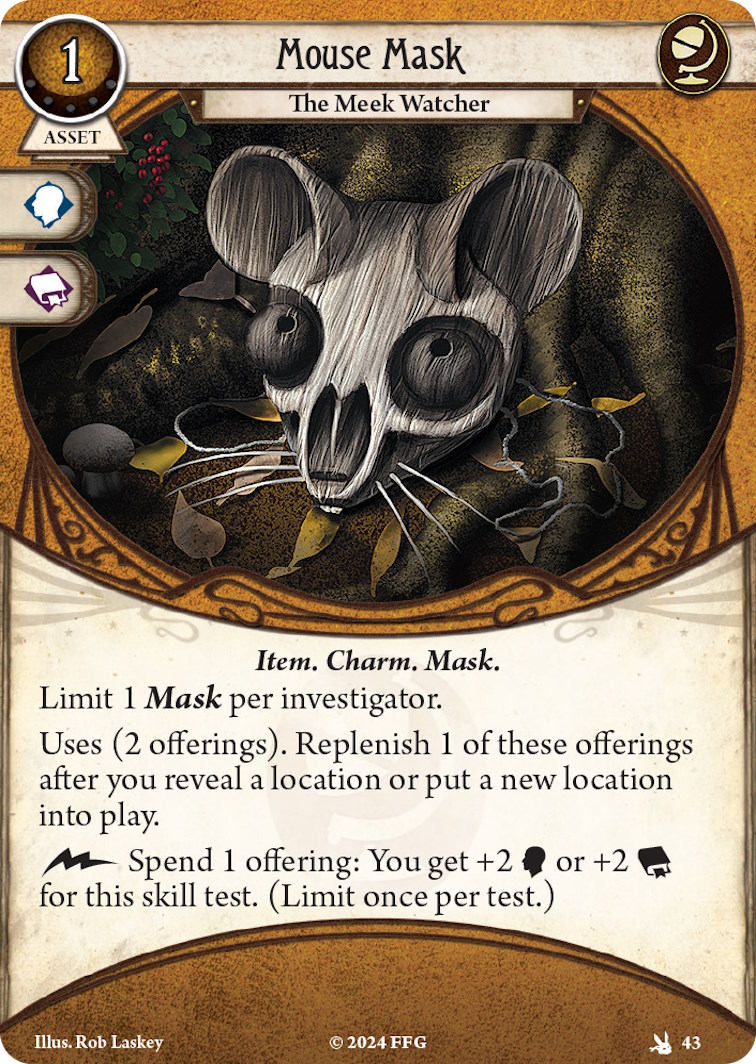
- Q: When an act or agenda instructs the players to reveal or put a new location into play, who is considered to have revealed it or put it into play for the purposes of card effects such as Mouse Mask or Whitton Greene that trigger “after you put a location into play?” A: Because acts and agendas are advanced by the players, as a group, each investigator is considered to have put the location(s) into play. (Official FAQ v2.4, July 2025)
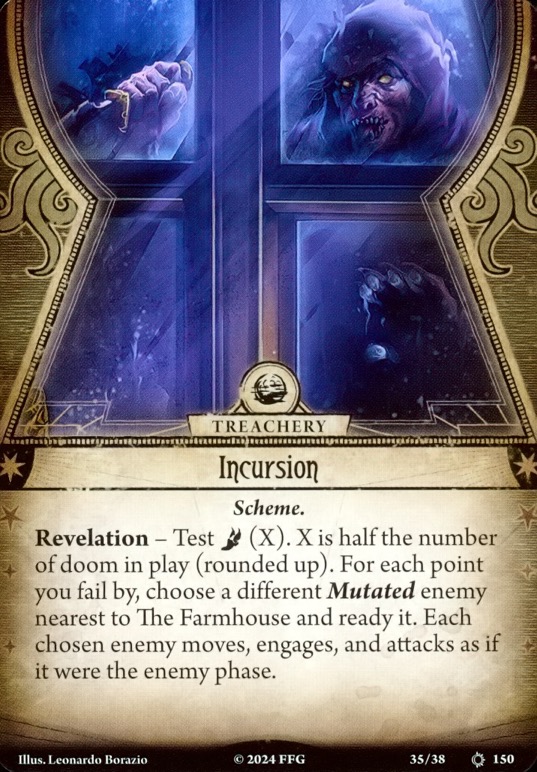
- Q: I have question about treachery card Incursion in Longest Night Scenario (Feast of Hemlock Campaign). If I fail, can I choose nearest enemy which is exhausted as a result of a decoy in this round (so it can't be readied for the remainder of the round) so this treachery does nothing when I choose this enemy, or I must choose different enemy which can do something (even though this treachery doesn't have the word "must")? A: No; enemies exhausted by decoys cannot ready for the rest of the round. This “cannot” is absolute and disqualifies them from being valid targets for Incursion. You must choose an enemy that you can ready, if able. (Ruling, April 2025)
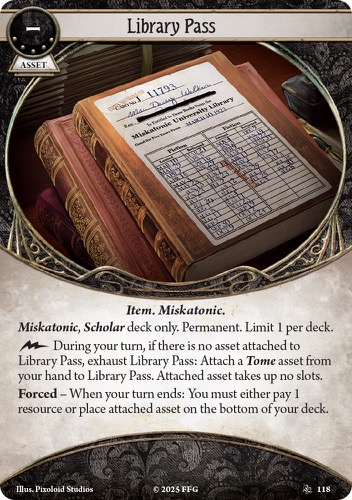
- Q: Arkham LCG Library Pass (Level 5) Is it the intention to compulsorily require paying 1 resource if there is no Tome attached? A: Yes; if no Tome asset is attached to Library Pass (5) when its Forced ability triggers, you must still pay 1 resource. (Ruling, March 2025)
-
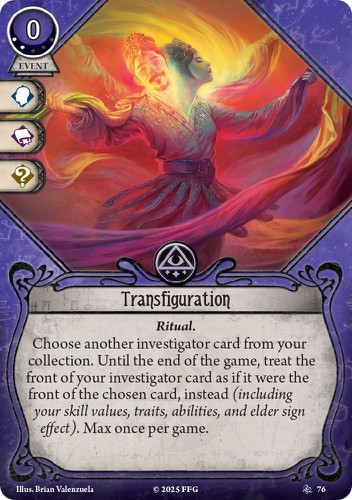
Q: I have a couple related questions about Transfiguration.
- When you use it while you have cards placed facedown beneath your investigator (say as Diana Stanley) and use Transfiguration, what happens to the cards beneath your investigator? If they stay there, are you able to use them if your new investigator front also interacts with cards facedown beneath them? (For example you Transfigure into George Barnaby from Diana Stanley. Can you now commit the facedown cards that were placed beneath you while you were Diana Stanley?)
- Additionally, how does the answer change for Investigators where the cards are not explicitly face down? Say for example you start as Sefina and Transfigure into Amanda? And likewise does the answer change when you go from an investigator with face up cards beneath them to an investigator that interacts with face down cards beneath them, or vice versa? Would you create two separate “stacks” of cards beneath you, one face up and one face down, and you’re only able to interact with the pile that is relevant for your current Investigator front?
-
A: Any cards beneath the original investigator card remain in their same position and state (e.g. faceup/facedown) when Transfiguration treats it as a new investigator card. As long as the new investigator card refers to such cards in the exact same way as the original, then the new one can interact with those cards as well. To be more specific:
- If the Diana Stanley player uses Transfiguration to treat their investigator card as George Barnaby’s, the facedown cards beneath the Diana card are/can be used for George’s abilities, including for checking George’s hand size or committing those cards to skill tests.
- If the Sefina Rosseau player uses Transfiguration to treat their investigator card as Amanda Sharpe, since both investigators place cards faceup beneath themselves, Amanda is able to use those cards for her ability, choosing one of them each time she performs a skill test that round. Note that when Amanda’s first ability discards “the card” beneath her, you should discard “each” card beneath her instead; you should only have multiple cards beneath Amanda for that one round.
- If the Diana player used Transfiguration to treat their investigator card as Amanda, they could not use cards placed facedown beneath their investigator card for Amanda’s abilities, because Amanda does not specifically interact with facedown cards. Similarly, if a player used Transfiguration to treat Sefina as George, the faceup cards beneath their investigator card could not be used for George’s abilities. (Ruling, March 2025) NOTE: Some of this is clarified further with FAQ v2.4, see below.
-
Q: Can I still use my investigator’s signature cards after using Transfiguration to treat the front of my investigator card as if it were a different investigator card? A: Yes. You are considered to be both investigators; the front of your investigator card is treated as the new investigator, but the back is still the old investigator. If you transfigure from Norman Withers into Ursula Downs , you can still play your signature Livre d'Eibon. (Official FAQ v2.4, July 2025)
-
Q: If I use Transfiguration and have cards placed beneath my investigator, what happens to those cards? A: Any cards placed beneath your investigator would remain there after using Transfiguration. If the new investigator card interacts with cards in the same state (faceup/facedown beneath the investigator card), the new investigator can interact with those cards. (Official FAQ v2.4, July 2025)
-
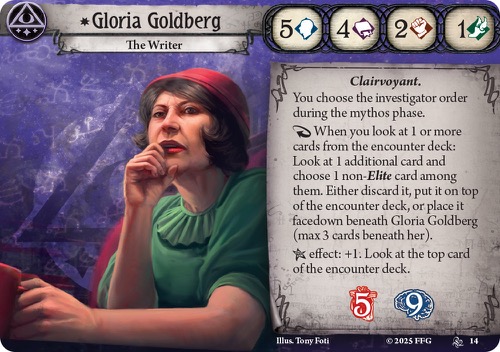
Q: During the Mythos phase, does Gloria choose the Investigator order ahead of all encounter draws, or does she determine which player gets each card right before each card is drawn? This is most relevant for Eye of Ghatanothoa, effectively whether Gloria has to decide the Investigator order based solely on the topmost card of the encounter deck, or whether she can evaluate the best remaining investigator for each encounter card as it’s revealed. A: Gloria Goldberg is able to choose which player gets each card right before the card is drawn. (Ruling, April 2025) NOTE: This is further clarified in FAQ v2.4 below.
-
Q: When Gloria Goldberg chooses the order in which investigators draw from the encounter deck during the mythos phase, are these cards drawn all at once and distributed in the chosen order, or are they drawn and resolved one at a time? A: The encounter cards are drawn and resolved one at a time. By extension, Eye of Ghatanothoa allows you to see each encounter card in turn before distributing these encounter cards. (Official FAQ v2.4, July 2025)